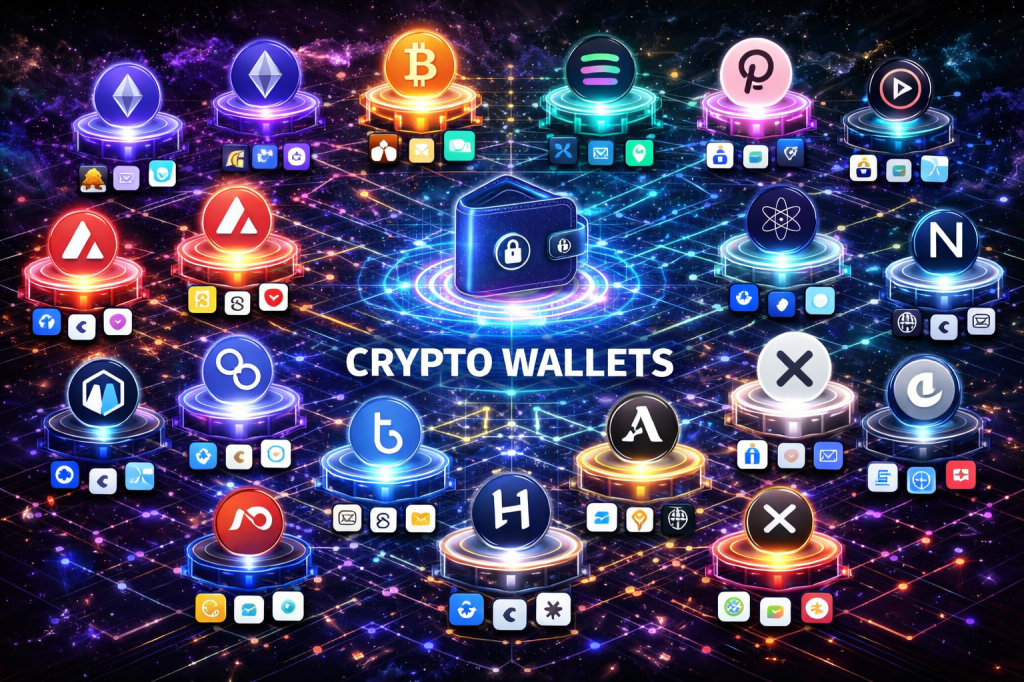
What Is a Crypto Wallet?
A crypto wallet is not a place where your money is physically stored.
That is the first misunderstanding most people have.
A wallet is a tool that gives you access to your assets on the blockchain.
At its core, a wallet does three things:
- Holds your private keys (your ownership)
- Allows you to send and receive transactions
- Connects you to blockchain networks and applications
If you control the keys, you control the assets.
If you do not, someone else does.
Types of Wallets (Know the Difference)
1. Hot Wallets (Connected to the Internet)
- Fast and convenient
- Used for daily transactions
- Examples: browser extensions, mobile apps
Risk: More exposed to hacks if not handled properly
2. Cold Wallets (Offline Storage)
- Hardware or offline storage
- Used for long-term holding
Advantage: Highest level of security
3. Custodial vs Non-Custodial
- Custodial: Someone else holds your keys (exchange accounts)
- Non-Custodial: You hold your keys (true ownership)
Rule: If you’re serious, you move toward non-custodial.
Purpose of Wallets in the Blockchain Ecosystem
Wallets are not just for storage—they are your gateway into the system.
They allow you to:
- Store and transfer value
- Stake and earn rewards
- Access decentralized finance (DeFi)
- Interact with smart contracts
- Own digital assets (NFTs, tokens)
- Participate in governance
Without a wallet, you are not participating—you are observing.
Choosing the Right Wallet (Reality Check)
Different blockchains require different wallets.
Some wallets support multiple networks, others are specialized.
The correct approach is simple:
- Use trusted wallets
- Match the wallet to the blockchain
- Start small and scale up
Blockchain Wallet Directory
Below is a curated list of major blockchains and reliable wallets to access each network.
Bitcoin (BTC)
The original digital money. Built for security and simplicity.
Wallets:
- Electrum — https://electrum.org
- Blockstream Green — https://blockstream.com/green/
Ethereum (ETH)
The foundation of DeFi, NFTs, and smart contracts.
Wallets:
- MetaMask — https://metamask.io
- Trust Wallet — https://trustwallet.com
Solana (SOL)
High-speed, low-cost transactions.
Wallets:
- Phantom — https://phantom.app
- Solflare — https://solflare.com
Cardano (ADA)
Research-driven and security-focused.
Wallets:
- Daedalus — https://daedaluswallet.io
- Yoroi — https://yoroi-wallet.com
Polkadot (DOT)
Designed to connect blockchains.
Wallets:
- Polkadot.js — https://polkadot.js.org/extension/
- Talisman — https://talisman.xyz
Avalanche (AVAX)
Built for fast decentralized applications.
Wallets:
- Core Wallet — https://core.app
- MetaMask — https://metamask.io
Cosmos (ATOM)
Interoperability between chains.
Wallets:
- Keplr — https://www.keplr.app
- Cosmostation — https://cosmostation.io
Chainlink (LINK)
Bridges real-world data to blockchain.
Wallets:
- MetaMask — https://metamask.io
- Trust Wallet — https://trustwallet.com
Tron (TRX)
Focused on decentralized content and media.
Wallets:
- TronLink — https://www.tronlink.org
- Trust Wallet — https://trustwallet.com
Tezos (XTZ)
Self-evolving blockchain.
Wallets:
- Temple Wallet — https://templewallet.com
- Kukai — https://kukai.app
Algorand (ALGO)
Efficient and scalable financial network.
Wallets:
- Pera Wallet — https://pera.app
- Defly — https://defly.app
Near Protocol (NEAR)
Built for usability and scaling.
Wallets:
- NEAR Wallet — https://wallet.near.org
- Sender — https://sender.org
Hedera (HBAR)
Enterprise-grade distributed network.
Wallets:
- HashPack — https://hashpack.app
- Blade Wallet — https://bladewallet.io
Stellar (XLM)
Global payment network.
Wallets:
- Lobstr — https://lobstr.co
- Freighter — https://freighter.app
Ripple (XRP Ledger)
Cross-border financial infrastructure.
Wallets:
- Xumm — https://xumm.app
- Ledger (Hardware) — https://ledger.com
Litecoin (LTC)
Fast and efficient payments.
Wallets:
- Litewallet — https://litewallet.io
- Electrum-LTC — https://electrum-ltc.org
Arbitrum
Ethereum scaling solution.
Wallets:
- MetaMask — https://metamask.io
- Rabby — https://rabby.io
Optimism
Lower-cost Ethereum transactions.
Wallets:
- MetaMask — https://metamask.io
- Rainbow — https://rainbow.me
Fantom (FTM)
High-performance smart contracts.
Wallets:
- MetaMask — https://metamask.io
- FWallet — https://fwallet.fantom.network
Internet Computer (ICP)
Decentralized internet infrastructure.
Wallets:
- NNS Wallet — https://nns.ic0.app
- Plug Wallet — https://plugwallet.ooo
Security Principles (Read This Twice)
- Never share your seed phrase
- Never store it digitally without encryption
- Always verify websites before connecting
- Use hardware wallets for serious holdings
This space rewards discipline and punishes carelessness.
Final Word
A wallet is not just a tool—it is your identity and access point into a new financial system.
Most people stay on the surface.
The ones who understand wallets properly are the ones who actually participate—and benefit.
 quantum-fi.org