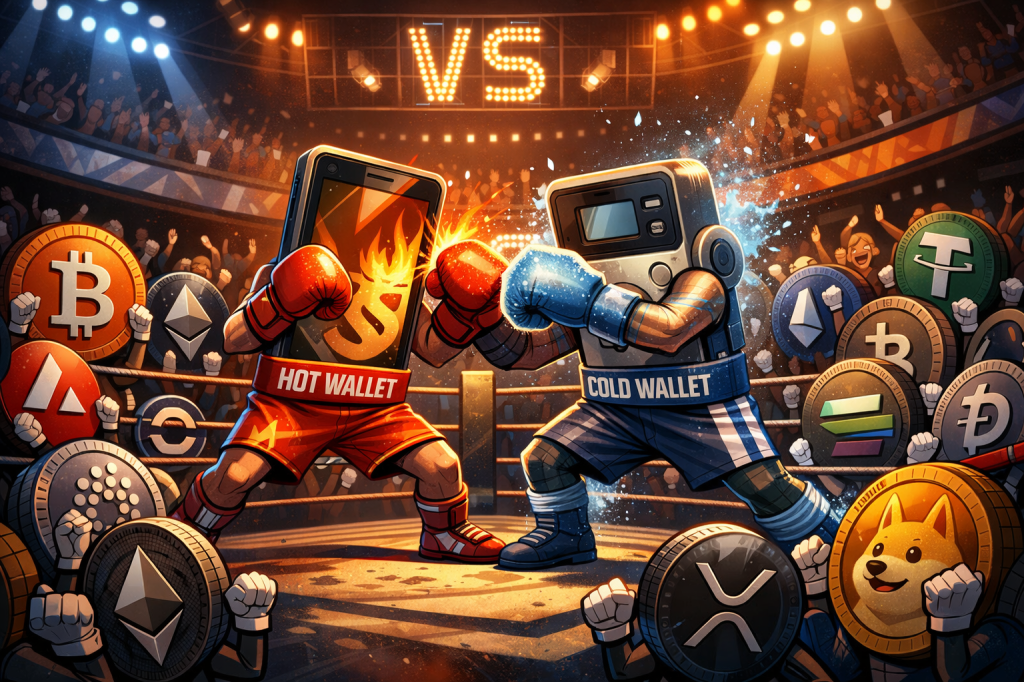
The biggest mistake people make in crypto isn’t what they buy—it’s how they store it.
Most people treat crypto like a stock account. It’s not.
Crypto gives you something traditional finance never has:
Direct ownership of your assets
But that ownership comes with responsibility. If you don’t understand where your assets are stored, you don’t truly control them.
This is where the difference between hot wallets, cold wallets, and exchange wallets matters.
The Three Types of Wallets (Simple Breakdown)
1. Exchange Wallets (Custodial)
Examples:
- Coinbase
- Gemini
These are the easiest to use.
How they work:
- The platform holds your crypto
- You access it through your account
- You do NOT control the private keys
Think of it like:
👉 A bank account
2. Hot Wallets (Software Wallets)
Examples:
- Exodus Wallet
How they work:
- Installed on your phone or computer
- You control your private keys
- Always connected to the internet
Think of it like:
👉 Your everyday spending wallet
3. Cold Wallets (Hardware Wallets)
Examples:
- Ledger Nano X
How they work:
- Physical device
- Private keys stored offline
- Not exposed to the internet
Think of it like:
👉 A safe or vault (like storing gold)
The Core Truth Most People Miss
Each type exists for a reason.
There is no “best wallet”—only the right combination.
Exchange Wallets: Pros and Cons
Pros
- Easiest for beginners
- Fast buying and selling
- Built-in staking options
- No need to manage private keys
Cons
- You don’t fully control your assets
- Accounts can be restricted or frozen
- Platform risk (even reputable ones)
Bottom line:
Use exchanges for access and activity—not long-term storage.
Hot Wallets: Pros and Cons
Pros
- You control your assets
- Easy to interact with apps and networks
- Flexible for transfers and usage
Cons
- Connected to the internet (higher risk)
- Requires responsibility (seed phrase security)
- Can be compromised if device is compromised
Bottom line:
Hot wallets are ideal for active use, not full storage.
Cold Wallets: Pros and Cons
Pros
- Highest level of security
- Completely offline
- True ownership and control
Cons
- Less convenient
- Requires setup and discipline
- If you lose your recovery phrase, assets are gone
Bottom line:
Cold wallets are for long-term storage and preservation of wealth.
The Best Strategy: Use All Three (The 3-Layer System)
This is where most people get it wrong—they try to pick one.
The correct approach is structure:
Layer 1: Exchange (Access Layer)
- Buying and selling
- Short-term funds
- Staking (easy, managed)
Layer 2: Hot Wallet (Interaction Layer)
- Moving assets
- Using decentralized apps
- Flexibility and control
Layer 3: Cold Wallet (Storage Layer)
- Long-term holdings
- Store of value
- Assets you don’t plan to touch
Staking: Where It Fits In
Staking is often misunderstood as “free money.” It’s not.
It’s participation in network operations—with risk.
Staking on Exchanges (e.g., Coinbase)
Pros:
- Simple
- No technical setup
- Automated rewards
Cons:
- Custodial (they control assets)
- Lower yields in some cases
- Less transparency
Staking in Hot Wallets
Pros:
- You maintain control
- Access to more networks
- Higher flexibility
Cons:
- More responsibility
- Requires understanding networks
Staking with Cold Wallets
Pros:
- Maximum security
- Long-term participation
Cons:
- More complex setup
- Not all assets supported directly
The Real Risk Isn’t the Market—It’s You
Most losses in crypto don’t come from price drops.
They come from:
- Poor storage decisions
- Leaving everything in one place
- Not understanding custody
A Simple, Practical Example
A balanced approach might look like this:
- 20–30% on an exchange (for liquidity and activity)
- 20–30% in a hot wallet (for interaction and flexibility)
- 40–60% in a cold wallet (for long-term storage)
This isn’t a rule—it’s a framework.
Final Thought
Crypto isn’t just a new asset class—it’s a new responsibility model.
You are your own bank, your own vault, and your own security system.
Most people won’t operate that way.
Those who do will understand something others don’t:
👉 Control matters more than convenience
 quantum-fi.org